The Cross-Industry Cost of Dropped Words: How Code-Switching Breaks AI Across India

There is a conversation happening right now in an Indian factory, a bank branch, and a hospital consultation room. In each of them, a professional is speaking naturally, mixing languages the way every educated Indian does instinctively, and in each of them, an AI system is producing output that ranges from slightly wrong to dangerously wrong.
The AI vendors who sold these systems would call this an edge case. It is not. It is the default case.
Code-switching, the practice of moving between two languages within a single conversation or sentence, is not a linguistic anomaly in India. It is the primary communication mode of urban and semi-urban India's professional workforce. The engineer who says "bearing wear ho raha hai, replacement schedule karo" is not speaking incorrectly. They are speaking efficiently, in the most natural register available to them. The voice AI that cannot understand them is the problem, not the speaker.
This post documents exactly what breaks, where it breaks, and what the operational cost of that breakage is, across the three sectors where the consequences are most severe: manufacturing and logistics, banking and fintech, and healthcare and pharma. If your organization uses voice AI in any of these sectors, you will recognize at least one of these failure modes. Possibly all three.
Why Code-Switching Breaks AI: The Technical Foundation
Before examining the sector-specific failures, it is worth establishing precisely why code-switching is not a problem that standard AI systems can handle with incremental improvement. It is a structural limitation of how those systems are built.
How acoustic models process speech
A speech recognition system works in two stages. First, an acoustic model maps the raw audio signal to a sequence of phonemes, the fundamental sound units of a language. Second, a language model takes those phoneme sequences and resolves them into words and sentences.
The critical constraint is in the first stage. Every acoustic model is built around a phoneme inventory: the set of sound units the model knows how to recognize. A model trained primarily on English has a rich English phoneme inventory. It can distinguish minimal pairs like "ship" and "chip" with high accuracy. Its Hindi phoneme inventory, if it has one at all, is sparse, trained on less data, and optimized for monolingual Hindi speech, not for Hindi phonemes appearing in the middle of English sentences.
When a speaker says "Machine ka temperature high ho gaya, coolant leak check karo," the acoustic model encounters a sequence where English phonemes ("machine," "temperature," "high," "coolant," "check") are interspersed with Hindi phonemes and grammar ("ka," "ho gaya," "karo"). The model has no framework for this interleaving. It does not cleanly hand off between phoneme inventories mid-utterance. It defaults to its strongest inventory, usually English, and attempts to interpret the Hindi segments through English phoneme mappings.
The result is not silence. It is something worse: confident, plausible-sounding errors. The Hindi segments are transcribed as phonetically similar English words or dropped entirely. The output looks like a mostly correct English sentence with gaps and substitutions that corrupt the meaning.
The language detection trap
Some systems attempt to solve this with a parallel language identification classifier. When the classifier detects a language shift, it signals the acoustic model to change mode.
This creates a new problem. Language classifiers need a window of audio to make a determination, typically one to three seconds. In fluid code-switched speech, a language shift happens within a single word. By the time the classifier confirms the shift, the acoustic model has already processed the switched segment in the wrong mode. The error is already in the output, and the classifier's late confirmation cannot retroactively fix it.
Language detection works for documents and long stretches of speech. It fails for the intra-sentence, intra-phrase code-switching that characterizes Indian professional communication.
Manufacturing and Logistics: When a Dropped Word Becomes a Safety Event
The daily reality of the shop floor
Walk through any Indian manufacturing facility and listen to the maintenance engineers, shift supervisors, and quality inspectors as they work. Their spoken language is a fluid mix of their regional language and English, with the English carrying the technical load: machine part names, fault codes, measurement units, procedure names, chemical compounds.
This is not carelessness. It is precision. There is no adequate Hindi equivalent for "bearing race," "tensile fatigue," or "hydraulic cavitation." The English term is the exact term. It belongs in the middle of the Hindi sentence because that is where the precision lives.
When a technician dictates a maintenance log, a safety observation, or a shift handover note into a voice AI system, this is the speech they produce. And this is the speech that breaks standard voice AI at the exact points that matter most.
What a corrupted maintenance log looks like
Consider a technician dictating: "Conveyor number 3 ki chain mein wear pattern dikh raha hai, sprocket teeth bhi damaged lag rahe hain, replacement urgent hai."
A code-switching-capable system produces: "Conveyor number 3 ki chain mein wear pattern dikh raha hai, sprocket teeth bhi damaged lag rahe hain, replacement urgent hai."
A standard Western voice AI produces something like: "Conveyor number 3 ke main..." followed by dropped or garbled segments where "wear pattern," "sprocket teeth," and "damaged" are misrecognized because they appear in a Hindi grammatical context the model was not trained on.
The first output is a complete maintenance record. The second is an incomplete one that either misses the fault description entirely or produces a plausible-sounding but incorrect substitution that a maintenance planner might not catch.
In a low-criticality scenario, the consequence is a missed PM task and incremental equipment degradation. In a high-criticality scenario, say a rotating equipment fault on a production line running hazardous chemicals, the consequence is an uncontrolled failure that an accurate maintenance record would have prevented.
The safety documentation exposure
Indian manufacturing safety regulations require accurate documentation of hazard observations, near-miss reports, and equipment condition findings. When these documents are generated through voice AI that corrupts code-switched input, the documentation compliance of the facility is undermined by the tool that was supposed to improve it.
An investigation following an industrial incident will review maintenance logs. A log that shows garbled or incomplete entries around the period when a technician verbally flagged a problem creates both a safety failure and a regulatory liability.
Logistics and supply chain: handover notes and dispatch errors
The problem extends beyond the factory floor into logistics operations. Dispatch supervisors, warehouse managers, and last-mile coordinators in Indian logistics operations dictate handover notes, exception reports, and routing instructions in code-switched language. A misrouted shipment traced to a voice AI transcription error is not an abstract risk. It is a daily occurrence in operations using standard voice AI tools at scale.
In industrial environments, a voice AI system with a 30 percent word error rate on code-switched speech is not a productivity tool with some limitations. It is an inaccurate documentation system that creates plausible-looking records that may not reflect what was actually said. That distinction matters when a record is reviewed after an incident.
Banking and Fintech: When Misrouting Destroys Customer Experience
The voicebot as the first line of service
Indian banks and fintech platforms have deployed AI voicebots at scale as the first point of contact for customer queries, dispute resolution, and transaction support. The business case is clear: reduce the volume of calls reaching human agents, cut average handle time, and improve availability outside business hours.
The business case depends entirely on the voicebot understanding what the customer is asking. And Indian banking customers do not ask questions in monolingual English.
The language mix of Indian banking customers
A customer calling to dispute a charge says: "Mera account se 2000 rupaye debit ho gaye, lekin transaction mera nahi hai, ye unauthorized transaction hai, please reverse karo."
A customer asking about a loan says: "Meri EMI bounce ho gayi, late payment charges kitna lagega, aur credit score pe kya impact hoga?"
A customer in Tamil Nadu says: "Naa oru NEFT transfer pannanum, beneficiary add aagala, error varuthu."
Each of these is a clear, specific, actionable request from a customer who knows exactly what they want. Each of them is code-switched. And each of them will confuse a voicebot whose natural language understanding pipeline was trained on either monolingual English or monolingual Hindi, but not on the fluid mixing pattern that the actual customer is using.
What happens when the NLU pipeline fails
When a voicebot misunderstands a code-switched utterance, the failure cascade follows a predictable path:
Intent misclassification. The NLU layer receives a partially garbled transcript from the acoustic model. Words dropped or misrecognized in the Hindi or regional language segments mean the intent classifier is working from an incomplete picture. "Unauthorized transaction" might be classified as a general account inquiry instead of a dispute, because the surrounding context that signaled urgency and dispute intent was in Telugu and was dropped.
Incorrect routing. The misclassified intent routes the call to the wrong queue or the wrong automated response flow. The customer who called to dispute a charge is now in the account balance inquiry flow.
Customer frustration and repeat prompts. The customer, realizing the bot has not understood them, repeats themselves, often with increasing frustration and increasing language mixing as they shift toward their more natural register. This compounds the misrecognition.
Agent escalation with no context. When the customer finally escalates to a human agent, the call transcript that the agent receives is corrupted. The agent does not know why the customer is frustrated or what they originally asked. They start from zero. Average handle time climbs.
The AHT and CSAT numbers
The business impact of voicebot code-switching failure is measurable in two key metrics.
Average Handle Time (AHT) for calls that pass through a failed bot interaction before reaching a human agent is consistently 40 to 70 percent higher than for calls that reach the agent through an accurate routing path. The wasted time in the bot flow, combined with the context loss at handoff, adds minutes to every failed interaction.
Customer Satisfaction (CSAT) scores for voice interactions involving bot misrouting are substantially lower than for successful automated resolutions. In banking, where customer trust is the foundational asset, a pattern of voicebot failures concentrated among customers who speak code-switched language creates a systematic service quality gap along demographic lines that is both commercially damaging and reputationally sensitive.
Digital banking and in-app voice features
The code-switching problem is not limited to phone-based voicebots. Indian fintech apps that include voice command features, voice-based transaction initiation, and conversational banking assistants face the same acoustic model limitations. A customer using a voice shortcut to initiate a transfer in a fintech app is using the same natural language register they use in conversation. The app that cannot understand them loses that interaction to manual navigation or, worse, loses the customer to a competitor.
Indian fintech platforms that have deployed native multilingual voice capabilities report 34 to 42 percent reductions in voicebot escalation rates compared to platforms using standard English-optimized acoustic models. The customers did not change. The model did.
Healthcare and Pharma: When the Dropped Word is a Clinical Fact
The stakes are categorically different
In manufacturing, a dropped word corrupts a maintenance record. In banking, a dropped word misroutes a customer. In healthcare, a dropped word can reach a patient.
Clinical documentation AI failure in code-switched speech is not a productivity problem. It is a patient safety problem with specific, traceable failure modes that clinicians, hospital administrators, and CMOs need to understand before deploying standard Western ambient scribes in Indian clinical settings.
How clinical code-switching actually sounds
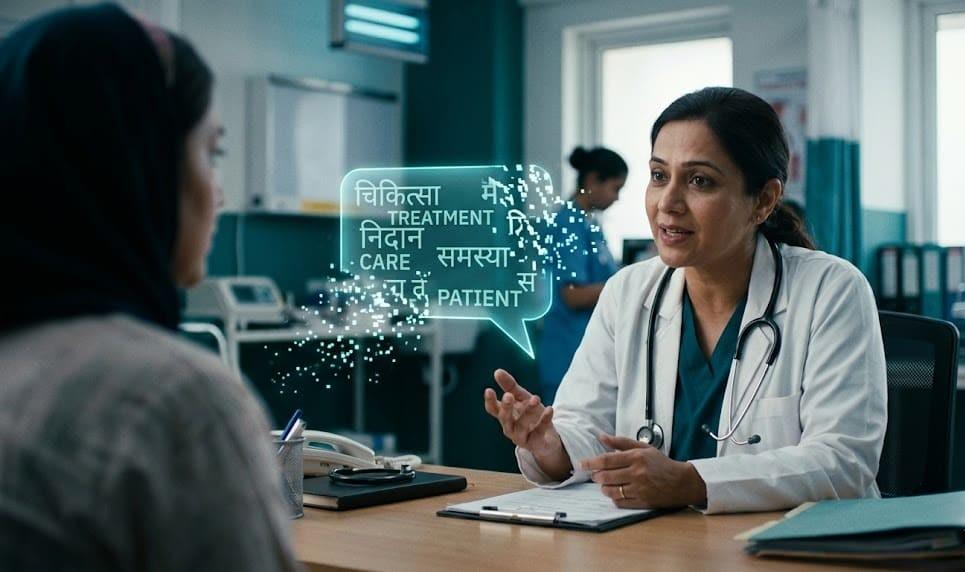
An Indian physician conducting an outpatient consultation in Hindi-dominant city speaks something like this:
"Patient 45 saal ke hain, Type 2 diabetes ke saath present kar rahe hain, HbA1c 9.2 hai, Metformin 1000mg OD pe hain lekin adherence poor hai, abhi Glipizide 5mg OD add karenge, hypoglycemia ke baare mein counsel karna hai."
Every clinical fact in that sentence is critical. The patient's age and primary diagnosis. The HbA1c reading. The current medication and dose. The adherence problem. The new medication being added. The counseling instruction.
The sentence is also entirely code-switched. The clinical terms (Type 2 diabetes, HbA1c, Metformin, OD, Glipizide, hypoglycemia) are English. The grammar, connectives, and clinical context are Hindi.
A standard Western ambient scribe processes this and produces a transcription where the English clinical terms are captured reasonably well and the Hindi connective tissue is dropped, garbled, or replaced with phonetically similar English nonsense.
The output note might read: "Patient 45... Type 2 diabetes... HbA1c 9.2... Metformin 1000mg OD... Glipizide 5mg OD..." with the adherence context, the rationale for the change, and the counseling instruction absent.
The three clinical failure modes
Failure mode 1: Lost dosage context. The physician says "Metformin 500mg, din mein teen baar" (three times daily). The AI captures "Metformin 500mg" and drops "din mein teen baar," leaving a medication entry with no frequency. A pharmacist or nurse working from that note is missing a critical instruction. The patient may receive the medication at the wrong frequency.
Failure mode 2: Lost contraindication and allergy flags. Patient-reported drug reactions are almost always communicated in the patient's primary language. A patient who says "Mujhe penicillin se allergy hai, rash aur swelling hoti hai" is communicating a safety-critical fact. A clinical AI that drops the Hindi description and captures only "penicillin" without the allergy marker has produced a documentation failure with direct patient safety implications. The allergy is in the room. It is not in the record.
Failure mode 3: Lost clinical rationale. When a physician documents the reasoning behind a diagnosis or treatment decision in code-switched speech, the English diagnosis term is typically captured and the Hindi reasoning is dropped. Reviewers, referring physicians, and medico-legal assessors reading that note see an assertion without support. In a case review or an audit, a note that says "started anticoagulation" without the Hindi-context reasoning that explains the specific thrombotic risk factors documented during the consultation is an incomplete clinical record.
The pharma dimension: adverse event reporting
Beyond clinical documentation, code-switching failures in pharma affect adverse event reporting quality. Field medical representatives and pharmacovigilance teams in India document adverse events in code-switched language. AI tools used to streamline adverse event capture that fail on code-switched input produce incomplete reports that miss the causal language, severity descriptors, and patient-reported symptom details that regulators require.
An adverse event report that reads correctly in its English structured fields but has lost the patient-reported context from the Hindi narrative is not a compliant pharmacovigilance record regardless of how the structured fields look.
The word error rate gap between monolingual English and Indian code-switched speech in standard clinical AI is 24 to 27 percentage points. In a clinical note where one word in four is wrong, the documentation is not a degraded version of the truth. It is a different document.
The Common Architecture Failure and What Solves It
The code-switching failures across manufacturing, banking, and healthcare share a single architectural root cause: the acoustic models powering these AI systems were built with a monolingual assumption that does not hold in Indian professional communication.
The solution is not a patch. It is not accent tuning. It is not a post-processing translation layer. It is an acoustic model with a polyglot phoneme inventory trained on real Indian code-switched speech from the operating environments where it will be deployed.
What the Adept Minds V2 model does differently
The Adept Minds V2 acoustic model was built specifically for the Indian code-switching reality across industrial, financial, and clinical environments.
Polyglot phoneme inventory. V2 uses a unified phoneme set drawn from English, Hindi, Tamil, Bengali, Telugu, and Marathi simultaneously. There is no language boundary trigger, no classifier latency, and no mode switch. The model processes code-switched utterances as a single coherent input, applying the appropriate phoneme mappings at the phoneme level rather than the utterance level.
Domain-specific vocabulary layers. V2 maintains separate vocabulary alignment layers for industrial technical terminology, financial and banking terms, and clinical medical vocabulary. English technical terms in each domain are recognized and preserved accurately regardless of the surrounding language context. "Sprocket" is "sprocket" in a Hindi maintenance log. "NEFT" is "NEFT" in a Telugu banking query. "Metformin" is "Metformin" in a Hindi clinical note.
Trained on real Indian operational speech. The training corpus for V2 includes de-identified recordings from actual Indian industrial, banking, and clinical environments across five states and four language mixing patterns. The model has heard the speech it will encounter in production, not a laboratory approximation of it.
Sovereign deployment, no audio egress. V2 runs entirely within your organization's infrastructure. In a manufacturing environment, it runs at the edge, on hardware within the facility. In a bank, it runs within the data center. In a hospital, it runs on a server within the hospital network. Audio never leaves the operating environment. The transcription output is what moves within the system, not the voice recording.
Across All Three Sectors: The Cost of Inaction
The organizations that will absorb the cost of code-switching AI failure over the next three years are the ones that are currently measuring their AI deployments against monolingual English benchmarks and calling the results acceptable.
The organizations that will gain ground on them are the ones that recognize the benchmark was wrong.
In manufacturing, the cost of inaction is corrupted maintenance records, preventable unplanned downtime, and safety documentation that does not accurately represent what was observed and reported.
In banking and fintech, the cost is elevated AHT, degraded CSAT, voicebot escalation rates that erase the automation ROI case, and a service quality gap that falls disproportionately on customers who are not monolingual English speakers.
In healthcare, the cost is incomplete clinical notes, missing dosage and allergy documentation, and a clinical record that does not accurately represent the physician-patient encounter it is supposed to document.
The voice AI problem in India is not that AI is immature. It is that the wrong AI was selected for the environment. That is a correctable error, and the correction is available now.
Frequently Asked Questions
What is code-switching and why does it break AI systems?
How does code-switching affect AI in Indian manufacturing?
How does code-switching affect voice AI in Indian banking and fintech?
How does code-switching affect clinical AI documentation in India?
What makes an acoustic model natively multilingual for Indian speech?
What is word error rate and why does it matter for enterprise AI?
See What Your Sector's Code-Switching Problem Actually Costs
Adept Minds offers a structured Voice AI Accuracy Assessment for organizations across manufacturing, banking, and healthcare that want to quantify the cost of their current system's code-switching failure rate.
We run your real operational audio samples through V2 and your current system side by side, measure the word error rate gap on code-switched speech specifically, and translate that gap into the operational and compliance cost it represents for your sector and use case.
The output is a single-page assessment your leadership team can act on.
Book a Voice AI Accuracy Assessment
A focused session for VPs and Directors across manufacturing, banking, and healthcare. We demonstrate the WER gap on code-switched speech from your sector, quantify the operational cost, and show you what V2 does differently.
- Side-by-side WER comparison on real Indian code-switched audio
- Sector-specific operational cost translation of your accuracy gap
- V2 architecture overview and sovereign deployment model
- Pilot scoping for your specific language environment and use case
About Adept Minds
Adept Minds builds sovereign acoustic AI for Indian enterprises. The V2 acoustic model is purpose-built for Indian code-switched speech across industrial, financial, and clinical environments, deployed on-premise with no audio leaving your infrastructure.
Contact our team or book directly above.
This article is written for informational purposes. Word error rate figures are based on internal evaluations, published independent research, and benchmarking against publicly available multilingual speech datasets. Individual results will vary by environment, language mix, and acoustic conditions. Adept Minds does not provide legal or compliance advice.