Solving the Hinglish Problem: Why Western Clinical AI Fails in Indian Hospitals
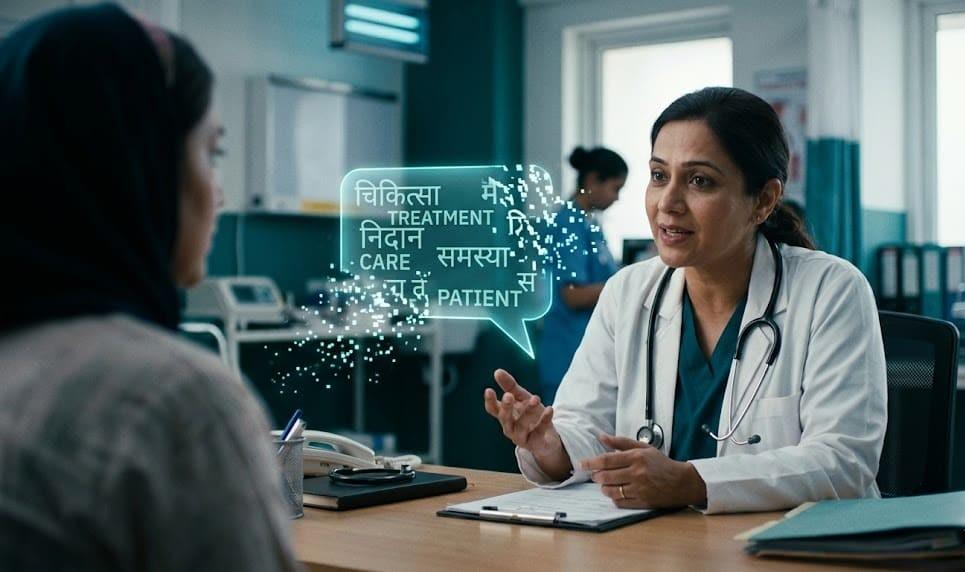
Picture a routine outpatient consultation at a busy urban hospital in Lucknow.
The physician greets the patient in Hindi. The patient describes their symptoms, switching to English for the medical terms they have picked up from previous visits. The physician clarifies in Hinglish. The patient's daughter, sitting beside them, adds context in a dialect that sits somewhere between Awadhi and standard Hindi. The physician, operating from years of training in both languages simultaneously, absorbs all of it without friction.
The ambient scribe running on the clinic laptop processes none of it correctly.
The transcription that appears on screen looks like this: a patchwork of correctly captured English fragments, misrecognized Hindi words rendered as phonetically similar English nonsense, and gaps where the model simply gave up and produced silence or a hallucinated phrase that sounds plausible but is clinically wrong.
The physician reads the note, sighs, and spends 12 minutes correcting it after the patient leaves.
This is the Hinglish problem. And it is not a minor edge case. It is the default clinical communication pattern for a majority of physician-patient interactions across urban and semi-urban India. If your hospital's clinical AI strategy is built on a Western ambient scribe platform, you have deployed a tool that is structurally incapable of solving the problem you actually have.
The Linguistic Reality of Indian Clinical Communication
Before examining why Western models fail, it is worth being precise about what they are failing on. The answer is more technically specific than "they do not understand Indian accents."
Code-switching is not a bug in Indian speech. It is the architecture.
Linguistics researchers use the term code-switching to describe the practice of alternating between two or more languages within a single conversation, or within a single sentence. In many multilingual contexts globally, code-switching is occasional and context-dependent. In Indian clinical settings, it is structural.
A physician trained at an Indian medical college acquired medical terminology in English, because that is the language of medical education in India. The same physician speaks Hindi, Telugu, Marathi, or Tamil at home and in informal conversation. When they sit across from a patient, both channels are active simultaneously.
The output of that interaction sounds like this: "Aapko kitne din se yeh problem hai? Dyspnea on exertion ke saath chest tightness bhi feel ho raha hai?" The sentence begins in Hindi, introduces a clinical term in English, continues in Hindi, and closes with a phrase that blends English gerund forms with Hindi auxiliary verbs.
This is not accented English. This is not broken Hindi. This is a grammatically coherent utterance in a blended language system that hundreds of millions of Indians use fluently every day and that no major Western speech recognition system was designed to handle.
The scope of the problem across Indian languages
Hinglish is the most widely discussed variant, but it is far from the only one. Indian hospitals in Chennai handle Tanglish (Tamil-English code-switching). Hospitals in Kolkata handle Benglish (Bengali-English). Hospitals in Pune handle Marathlish. Hospitals in Hyderabad handle Tenglish (Telugu-English). Each of these mixing patterns has its own phoneme transitions, its own grammatical structures for embedding English terms into non-English syntax, and its own set of regional pronunciation characteristics for English medical vocabulary.
Western ambient scribe vendors, when asked about this, typically say two things. First: their models support multiple languages. Second: users should configure the system to detect the language being spoken.
Both statements are technically true and operationally useless. Supporting multiple languages in sequence is not the same as handling code-switching within a single utterance. And language detection systems that require a pause or a clear language boundary to switch acoustic models are precisely what fails when a physician says "Patient ko fever hai with associated chills aur rigors."
How Western Acoustic Models Are Built and Why That Creates the Problem
To understand why standard clinical AI fails on code-switched speech, it helps to understand how acoustic models are trained.
The monolingual training assumption
A speech recognition acoustic model learns to map acoustic signals (the raw sound waveform) to phoneme sequences (the building blocks of speech sounds) and then to words. This mapping is learned from training data: recordings of speech paired with accurate transcriptions.
The dominant acoustic model architectures in commercial clinical AI, variants of transformer-based models like Whisper and its derivatives, were trained predominantly on English speech data. The English training corpora are large, diverse, and well-annotated. The Indian language training data, where it exists at all in these pipelines, is typically:
- Monolingual (pure Hindi, pure Tamil, pure Bengali, not mixed)
- Formal and read-aloud rather than conversational
- Not drawn from clinical environments
- Significantly smaller in volume than the English component
The result is a model that has a rich, confident phoneme inventory for English and a thinner, less confident one for Indian languages. When the model encounters a Hinglish utterance, it does not switch gracefully between two phoneme systems. It defaults to the one it knows best (English) and attempts to interpret Hindi phonemes through English phoneme mappings. The output is transcription errors that range from funny to clinically dangerous.
The language detection boundary problem
Some systems attempt to address this by running a language identification classifier in parallel with the acoustic model. When the classifier detects a language switch, it signals the acoustic model to change its operating mode.
This approach has a fundamental limitation that makes it unsuitable for clinical code-switching: it requires a detectable boundary. Language identification classifiers look for patterns across a window of audio, typically 1 to 3 seconds, to determine which language is being spoken. In fluid code-switched speech, the boundary is not a pause or a clear transition. It is a single word, embedded in the middle of an utterance, that belongs to a different language than the words on either side of it.
By the time the classifier detects the boundary, it has already passed. The acoustic model has already attempted to transcribe the switched segment using the wrong phoneme system. The error is already in the output.
Why Indian accents alone are not the issue
A common misconception is that Indian clinical AI failures are primarily an accent problem, that Western models trained on American English simply do not handle Indian-accented English well. Accent is a real factor, but it is a secondary one.
An Indian physician speaking medical English with an Indian accent is, linguistically, speaking English. The acoustic model can be fine-tuned on Indian-accented English and achieve reasonable accuracy. The products that claim "Indian English support" are addressing this problem, and they address it reasonably well.
What they do not address is the transition out of English and back. A physician who says "The patient's haemoglobin hai 9.2 grams per deciliter" has produced an utterance where a single Hindi copula ("hai," meaning "is") sits between English clinical content on both sides. The acoustic model trained on Indian English has no framework for that transition. It either drops the Hindi word, misrecognizes it as a similar-sounding English word, or inserts a hallucinated English filler.
In a haemoglobin reading, the number survives. In a medication dosage, an allergy description, or a contraindication flag, the error can reach the patient.
The Clinical Consequences of Transcription Failure
Transcription errors in clinical documentation are not a productivity inconvenience. They are a patient safety issue with specific, traceable downstream consequences.
Medication errors from misrecognized dosages and drug names
Drug names in Indian clinical speech are a particularly high-risk zone for code-switching transcription failures. A physician might say "Metformin 500 milligram, din mein do baar" (Metformin 500 milligram, twice a day). A model that misrecognizes "do baar" (twice daily) as a garbled English phrase and drops it produces a medication entry with no frequency. A pharmacist or nurse working from that note is missing a critical instruction.
Missed diagnoses from dropped clinical terminology
When a physician documents an assessment in code-switched speech, the diagnostic terms are typically in English while the explanatory context is in Hindi. If the Hindi context is systematically misrecognized, the clinical rationale for the diagnosis does not appear in the note. Reviewers, referral physicians, and insurers reading that note see an assertion without support, which creates documentation quality problems and, in more serious cases, missed clinical reasoning that the referring physician needed.
Allergy and contraindication failures
Patient-reported allergies and adverse drug reactions are often communicated in the patient's primary language, which is frequently not English. A patient who says "Mujhe penicillin se problem hoti hai, rash aata hai" (I have problems with penicillin, I get a rash) is communicating a critical safety fact. A clinical AI that misrecognizes the Hindi context and captures only "penicillin" without the allergy flag has produced a documentation failure with direct patient safety implications.
The word error rate for Western ambient scribes on Hinglish clinical speech averages 28 to 35 percent in independent evaluations. In monolingual English clinical settings, the same systems achieve 4 to 8 percent word error rate. The gap is not a minor performance difference. It is the difference between a usable tool and a liability.
How the Adept Minds V2 Acoustic Model Is Built Differently
The Adept Minds V2 model was designed from the ground up for the Indian clinical speech environment, not adapted from a model optimized for a different context.
Polyglot phoneme inventory with seamless mid-utterance transitions
The core architectural difference in V2 is the phoneme inventory. Standard models operate with a single-language phoneme set and switch between sets at language boundaries. V2 uses a polyglot phoneme inventory: a unified set of phonemes drawn from English, Hindi, Tamil, Bengali, Telugu, and Marathi that the model can draw on simultaneously within a single utterance.
This means that when the model processes "Patient ko fever hai with associated chills aur rigors," it does not encounter a language boundary requiring a mode switch. It processes the entire utterance against a phoneme inventory that natively contains both the English phonemes for "fever," "chills," and "rigors" and the Hindi phonemes for "ko," "hai," and "aur." The transition is handled at the phoneme level, not the language level.
The result is accurate transcription of code-switched utterances without the boundary detection latency that causes errors in competing approaches.
Training corpus: real Indian clinical conversations
V2 was trained on a curated corpus of de-identified Indian clinical conversations spanning outpatient, inpatient, and emergency settings across five states and four language mixing patterns. The corpus includes consultations in Hinglish, Tanglish, Benglish, and Telugu-English, recorded in real clinical environments with real ambient noise conditions.
This is not supplementary fine-tuning on top of a Western base model. The clinical Indian speech patterns are in the foundational training data, which means the acoustic model's phoneme-to-word mappings are calibrated to Indian clinical speech at the architecture level, not patched in afterward.
Medical vocabulary alignment across both language streams
Clinical terminology in Indian hospitals follows a specific pattern: English medical terms (ICD categories, drug names, procedure names, anatomy) embedded in Hindi or regional language grammatical structures. V2 includes a clinical vocabulary layer that recognizes English medical terms regardless of the surrounding language context, and preserves them in the transcription output without attempting to translate or phonetically adapt them to the surrounding language's phoneme patterns.
This means "dyspnea on exertion" remains "dyspnea on exertion" in the transcription even when it appears in the middle of a Hindi sentence, rather than being misrecognized as a phonetically similar Hindi phrase.
Dialect and regional accent variation
Within Hindi alone, the phoneme realizations for the same word vary significantly between speakers from Delhi, Lucknow, Bhopal, Patna, and Jaipur. V2 was trained with regional speaker variation as an explicit variable, covering accent profiles from twelve Hindi-speaking states and four major South Indian states. The model does not assume a standard accent. It handles the range.
Sovereign Deployment: Why Audio Must Not Leave the Building
Clinical audio is among the most sensitive data categories that a hospital generates. A recording of a physician-patient consultation contains:
- The patient's name, spoken aloud
- Details of their presenting complaint
- Their medical history, often including sensitive conditions
- Potentially their financial situation, family context, and social circumstances
- The physician's clinical reasoning and differential diagnosis
Under India's DPDP Act, this is sensitive personal data with the highest level of protection. Routing it to a cloud server for transcription, regardless of the vendor's data protection commitments, creates a cross-border transfer compliance problem that no standard commercial agreement currently resolves for Indian hospitals.
Beyond the legal exposure, there is the patient consent dimension. Most patients in Indian hospitals have not been informed that their consultation audio is being transmitted to a server outside India for AI processing. Obtaining that consent is complicated, and for many patients, particularly elderly or less educated patients, meaningfully explaining what that means is not straightforward.
The V2 ambient scribe eliminates this problem architecturally. The acoustic model runs on a GPU server within your hospital network. Audio is processed locally. The transcription output is what leaves the server, not the audio. Patient voices never travel beyond the hospital's own infrastructure.
This is not a compromise on capability. The V2 model runs on hardware that a mid-size hospital can deploy and maintain without specialized AI infrastructure teams.
What a V2 Deployment Changes for Physicians
The business case for CMOs is ultimately about physician time and documentation quality, not acoustic model architecture. Here is what changes operationally when V2 is deployed as the ambient scribe.
Documentation time per consultation drops from 8 to 14 minutes to under 2 minutes. The physician reviews a pre-populated note rather than writing one. Correction rates on V2 output in Indian clinical settings are low enough that most notes require only minor edits before sign-off.
Physician attention during consultations increases. When documentation is being handled accurately in the background, the physician is not mentally drafting the note while the patient is speaking. Physicians report higher consultation satisfaction and more complete history-taking when they know the ambient scribe will capture it correctly.
The notes are better. Because V2 captures the full consultation including the Hindi context that describes symptom duration, severity descriptors, and patient-reported history, the resulting notes are more complete than notes dictated or typed after the consultation from memory.
Referral and discharge documentation becomes faster. Structured note output from V2 includes automatically populated sections for history, examination, assessment, and plan, formatted for your hospital's existing note structure. Referral letters and discharge summaries can be drafted from the structured note output in minutes rather than the 20 to 35 minutes a detailed summary typically takes.
Physicians in V2 pilot deployments report recovering an average of 90 minutes per clinical day previously spent on documentation. At a 250-day working year, that is 375 physician hours per year per doctor, returned to direct patient care.
Why This Is a CMO Decision, Not Just an IT Decision
Ambient scribe technology is sometimes positioned as an IT infrastructure decision: evaluate vendors, check integration with the HIS, negotiate the contract, deploy. The clinical technology team manages it from there.
This framing misses the professional stakes involved.
Clinical documentation is a medico-legal record. Every note generated by an ambient scribe is a document that carries the treating physician's signature and can be produced in a malpractice proceeding, an insurance audit, an accreditation review, or a regulatory inquiry. If that document contains transcription errors introduced by a model that could not handle the language the physician was actually speaking, the physician is the one who signed it.
CMOs have an institutional responsibility to ensure that the tools their physicians use for documentation meet a clinical accuracy standard, not just a general speech recognition accuracy standard. For Indian clinical environments, that standard requires demonstrated performance on code-switched speech, not on monolingual English benchmarks.
Selecting an ambient scribe based on KLAS ratings from US health systems or NHS pilot data is selecting a tool calibrated for a clinical communication environment that is fundamentally different from the one your physicians are operating in every day.
The Hinglish problem is not a nuisance to be tolerated while vendors "improve their Indian language support." It is a structural accuracy gap in tools that affect patient safety documentation, and it requires a structural solution.
Frequently Asked Questions
Why do Western clinical AI tools fail in Indian hospitals?
What is Hinglish and why does it matter for clinical AI?
What is code-switching in clinical speech?
What is an ambient clinical scribe?
How does Adept Minds V2 handle Indian language mixing?
Does an ambient scribe need to send audio to the cloud?
See V2 in Your Clinical Environment
The most direct way to understand what V2 does differently is to see it transcribe a real Indian clinical consultation.
Adept Minds offers a structured Clinical Evaluation Session for Chief Medical Officers and clinical technology leads at qualifying hospital systems. In a 45-minute call, we walk through a live demonstration using real code-switched clinical audio samples, show you word error rate comparisons against leading Western ambient scribe platforms, and discuss what a pilot deployment would look like in your specific specialty and language environment.
There is no obligation beyond the conversation.
Book a Clinical Evaluation Session
A 45-minute session for CMOs and clinical technology leads. Live demonstration, side-by-side accuracy comparison, and a discussion of your specific clinical environment.
- Live V2 demo on Hinglish and code-switched clinical audio
- Word error rate comparison vs leading Western platforms
- DPDP compliance architecture walkthrough
- Pilot deployment scoping for your hospital and specialty mix
About Adept Minds
Adept Minds builds sovereign clinical AI for Indian hospitals. Our V2 ambient scribe platform is the only ambient documentation system purpose-built for code-switched Indian clinical speech, deployed on-premise with no audio leaving the hospital network.
Contact our clinical AI team or book directly above.
This article is written for informational purposes. Word error rate figures and physician time savings are based on internal evaluations and published independent research. Individual results will vary based on clinical environment, specialty, and language mix. Adept Minds does not provide legal or compliance advice.